
By Jeremiah Aut
The best AI marketing tools rarely look impressive in a demo; they just quietly save you hours every week.
The best AI marketing tools for small business owners aren’t the flashiest ones, they’re the handful that solve one specific, expensive problem and nothing more. By the end of 2026, more than 80% of small businesses will be using AI for marketing. 54% already do, and another 27% plan to start this year, according to Constant Contact’s survey of 1,500+ SMB owners. In one calendar year, AI tools go from a slight majority to nearly universal.
Which means the interesting question is no longer whether to use AI marketing tools. It’s which ones, because the market has responded to that adoption curve with hundreds of subscriptions, most of which you don’t need.
Here’s an honest guide to the best AI marketing tools for small business in 2026, organized by the job you’re hiring them to do. No affiliate links, no “top 40” padding, just the short list, plus the categories where saving your money is the right call.
Looking for the full buy list rather than the skip list? That is the 2026 AI marketing tool stack, which walks through the 15 tools worth paying for, organized by the job you are hiring them to do. This page is the other half of that: what to cancel.
The one rule before buying any AI marketing tool
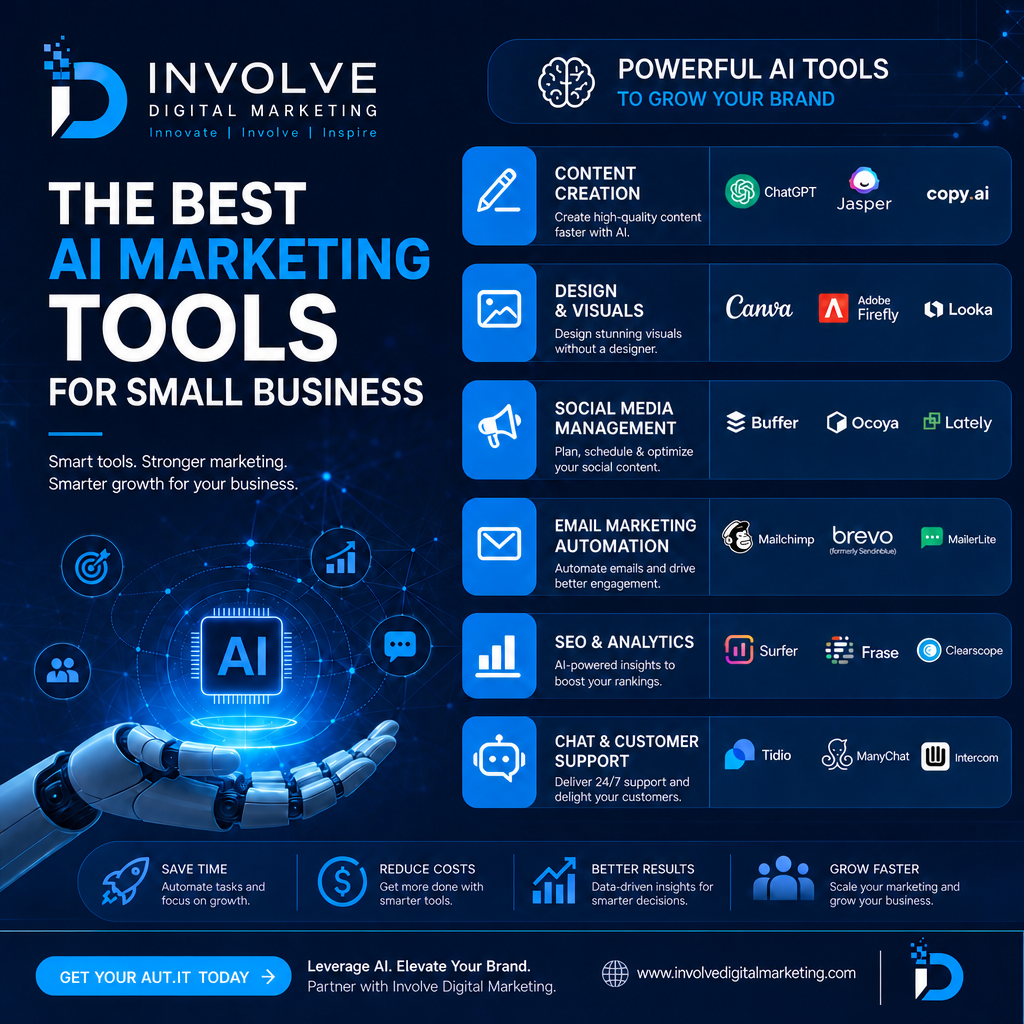
Buy for a bottleneck, not a capability. The right question isn’t “what can AI do?” It’s “what marketing task eats hours every week or simply doesn’t get done?” Pick a tool for that, use it until it’s routine, then consider the next one. Five well-used tools beat twenty subscriptions you tour once. Most owners we work with in the Jacksonville area need three or four, total.
Category 1: A general AI assistant, and this is where most of the value is
ChatGPT, Claude, or Gemini, $0–20/month.
Before any specialized tool, one general assistant covers an enormous share of small business marketing work: drafting emails and social posts, brainstorming offers, summarizing competitor sites, rewriting your service pages in plain English, building outlines. The free tiers are genuinely usable; the ~$20 paid tiers are the best value in this entire article.
The catch: output quality tracks input quality. “Write me a Facebook post” gets you mush. “Write a 3-sentence Facebook post for a Fleming Island lawn care company announcing fall aeration season, plain voice, no exclamation points” gets you something publishable. The tool is a fast junior employee. It still needs a brief.
Category 2: Design and video
Canva (with Magic Studio), free to ~$15/month. Still the standard for non-designers, and the AI additions are practical rather than gimmicky: generate layouts, resize one design for every platform, remove backgrounds in a click. If you make your own social graphics, flyers, or menus, this is a justified subscription.
A short-video tool (e.g., Creatify, ~$19/month), only if video is actually in your plan. AI video ad generators have gotten decent for simple product/service spots. But don’t buy a video tool as an aspiration. Buy it the week you commit to a video cadence, not before.
Category 3: Email and CRM, where AI earns real money
Your CRM’s built-in AI (HubSpot from ~$18/month, or similar). The highest-ROI AI in 2026 isn’t a standalone gadget. It’s the AI already inside the platforms that hold your customer data. Drafting follow-up emails from contact context, scoring leads, suggesting next steps: useful precisely because it’s connected to your actual pipeline. If you’re already on HubSpot, Mailchimp, or Constant Contact, learn its AI features before adding anything new.
Klaviyo (from ~$20/month), for ecommerce specifically. AI-driven segmentation and send-time optimization pay for themselves if you sell products online. Service businesses can skip it.
Category 4: SEO research
Semrush or Ahrefs (~$130–140/month), powerful and honestly more than most small businesses need. These are professional-grade tools; agencies (including ours) live in them. If you’re doing your own SEO seriously, the subscription can be justified. If you’d log in twice, don’t. Google Search Console plus Google Business Profile insights are free and cover the essentials: what you rank for, what people click, what needs fixing.
Category 5: Automation glue
Zapier or Make (free tier to ~$30/month). Not glamorous, quietly transformative: new lead fills out a form → contact created in CRM → notification hits your phone → follow-up email queued. This is the connective tissue that makes the other tools compound, and it’s the foundation of most of the AI automation work we build for clients. The free tiers handle simple flows; you’ll know when you’ve outgrown them.
That said, free trials are worth testing before you commit to a subscription.
What’s not worth paying for in 2026
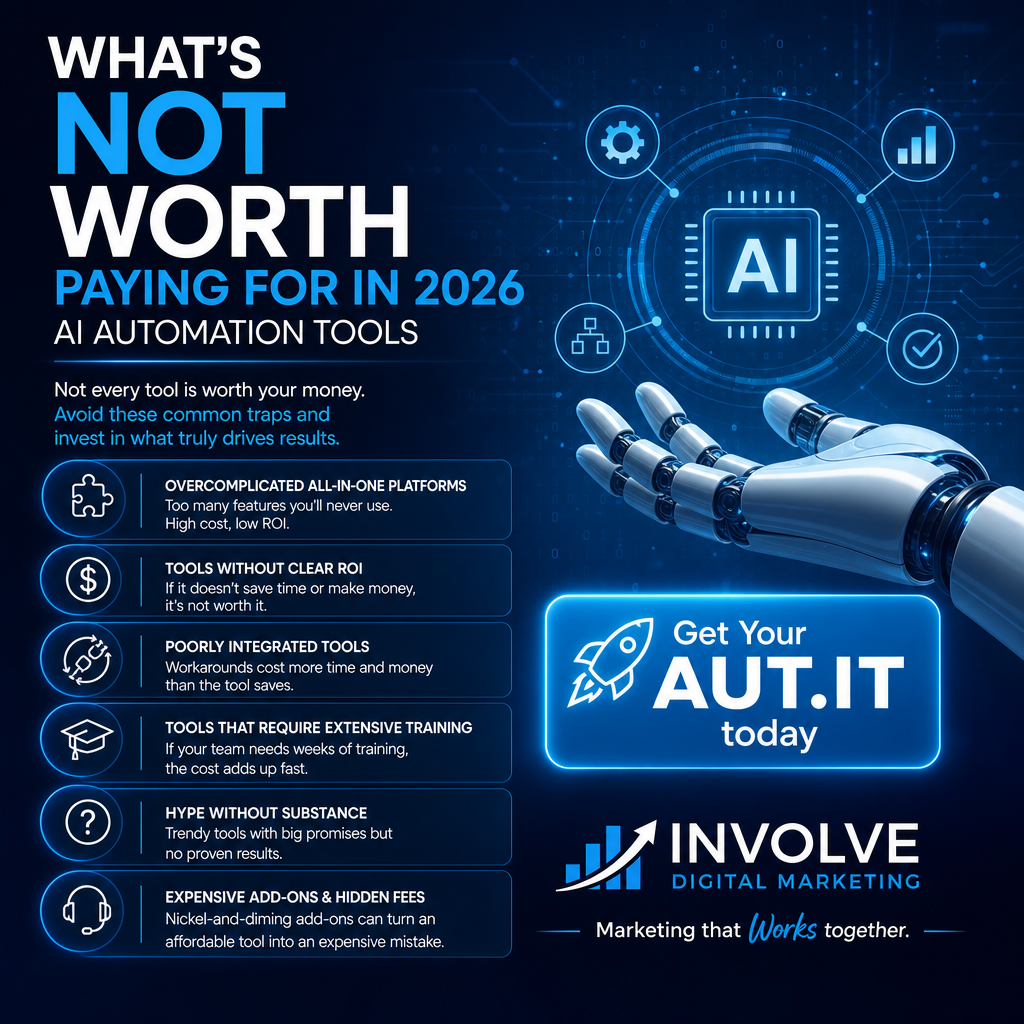
- AI content mills promising dozens of SEO articles a month. Volume without substance now hurts more than it helps. The full argument is in our post on AI-generated content and SEO.
- Overlapping writing subscriptions. Jasper and Copy.ai are competent, but if you already pay for ChatGPT or Claude plus your CRM’s AI, a third writing tool is usually redundant. Pick one home for writing.
- “AI-powered” relabels. Plenty of tools added a chatbot and doubled the price. If the AI feature doesn’t change your workflow, it’s marketing, theirs, not yours.
- Anything sold annually before you’ve used it weekly for a month. Monthly first. Always.
In fact, most owners only need two or three tools, not ten.
A sane starter stack (~$40–60/month total)
- One general assistant (ChatGPT or Claude, $20)
- Canva ($15)
- Your existing CRM’s AI tier ($18–25)
- Zapier free tier connecting them
That stack, actually used, outperforms a $500/month pile of unopened tabs. Add a category only when a bottleneck demands it, and if the bottleneck is time to run any of it, that’s the point where handing the system to someone is cheaper than another subscription. (That’s also where the line between “tools” and AI agents starts to blur.)
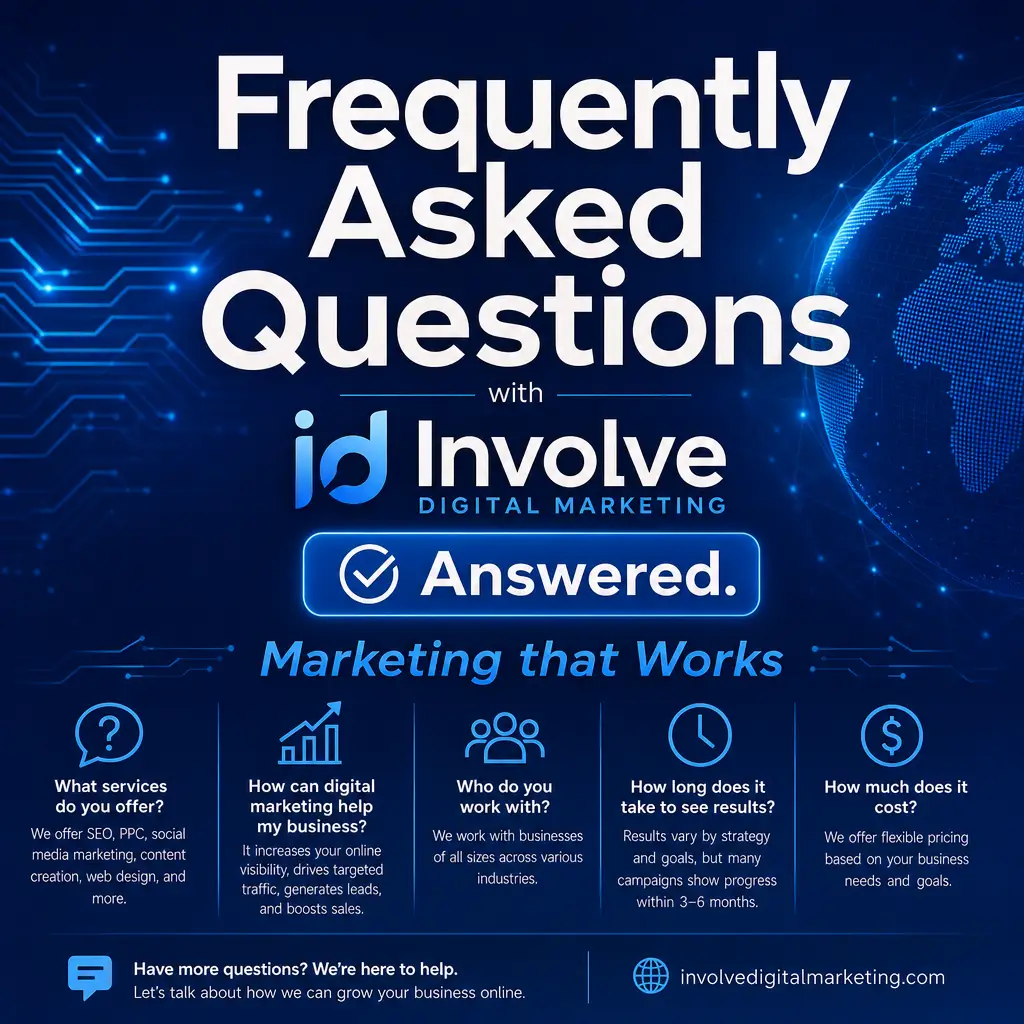
Frequently asked questions
What’s the single best AI marketing tool for a small business just starting out?
A general assistant (ChatGPT, Claude, or Gemini) used with specific, detailed prompts. It replaces the blank page across email, social, and web copy, which is where most owners lose the most time. Everything else is situational.
Are free AI tools good enough, or do I need paid plans?
Free tiers are genuinely workable for testing whether a tool fits your routine. Upgrade when you hit a real wall (usage limits, watermarks, missing integrations), not preemptively. The exception: the ~$20 general assistant tier, which pays for itself almost immediately if you write anything weekly.
Will AI tools replace hiring a marketing agency?
For execution tasks (drafting, resizing, scheduling) they replace a lot, and that’s genuinely good for small budgets. What they don’t supply is strategy, judgment, and the discipline of consistent use; most AI subscriptions fail for the same reason gym memberships do. Whether you run the tools or someone like us does, the tools are the cheap part.
How do I keep AI-written content from sounding generic?
Feed it specifics: your city, your services, your actual customer questions, your voice rules (“plain-spoken, no hype”). Then edit before publishing. AI drafts; you decide. Anything published straight from the machine reads like it.
Are the best AI marketing tools for small business different for service businesses vs. retail?
The core stack is similar, but service businesses lean harder on CRM and follow-up automation, while retail and e-commerce get more value from AI-assisted product descriptions, ad creative, and inventory-driven email campaigns.
Drowning in tool options, or paying for six and using two? Bring your current stack to a free 30-minute audit. We’ll tell you what to keep, what to cancel, and what to connect. We’ll happily talk you out of spending money where the free tier does the job.