
NAP Consistency means your business name, address, and phone number appear identically everywhere they show up online.
The short version of what the evidence supports in 2026: making your own website match your Google Business Profile matters a lot. Chasing identical formatting across dozens of third-party directories matters far less than the industry has told you for a decade. And the reason to keep listings clean is mostly defensive, because Google, competitors, and AI systems all change your business data without asking you.
That is a narrower claim than you will read almost anywhere else. Here is the evidence behind it.
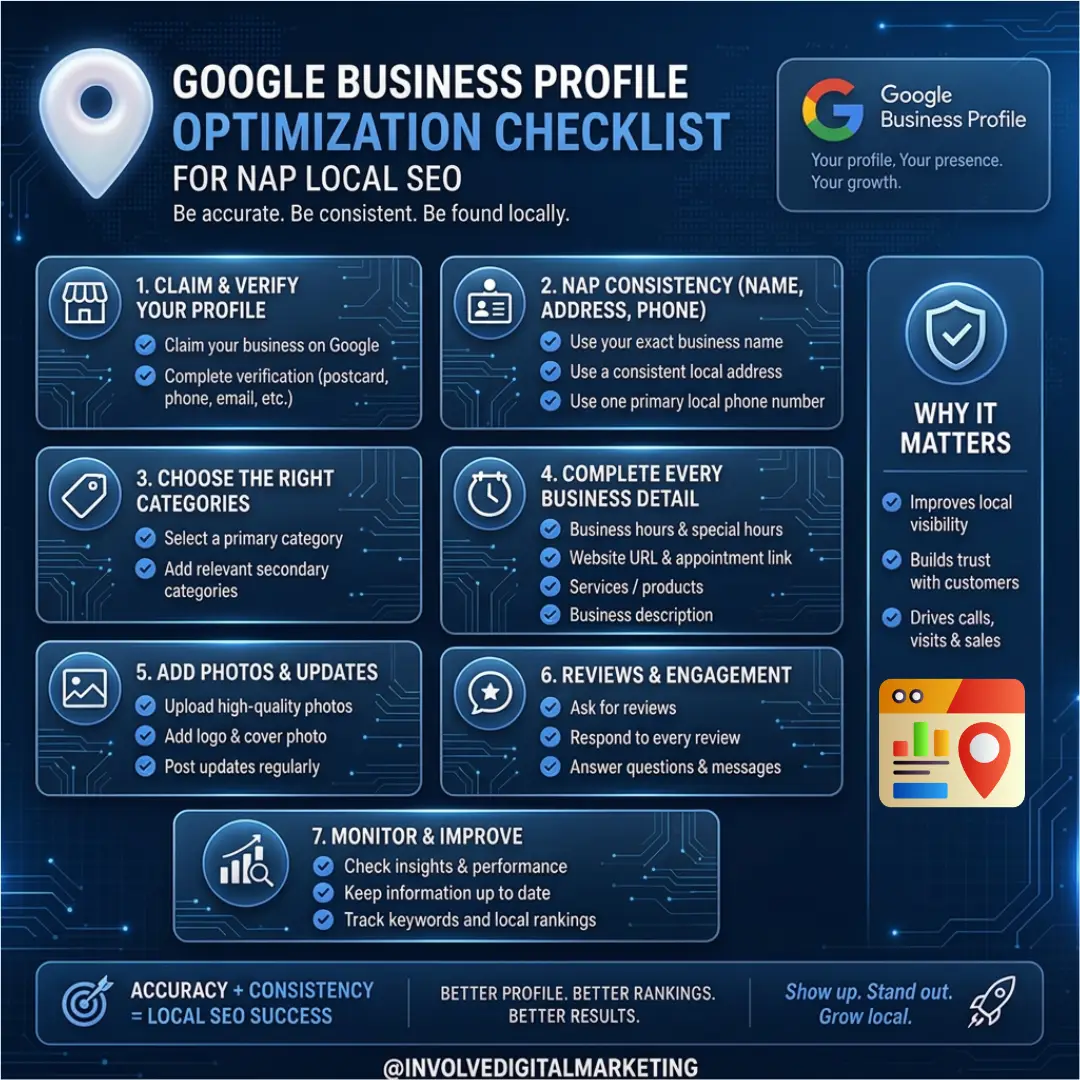
What NAP consistency actually is
NAP stands for Name, Address, Phone. A “citation” is any place online where those three details appear together: your Google Business Profile, Yelp, Facebook, Apple Maps, the chamber of commerce directory, an industry association listing, a sponsorship page, your own website footer.
The theory is that search engines treat these mentions as evidence about a single real-world entity. When the evidence conflicts, confidence drops.
Google does not phrase it that way, but it does confirm the underlying mechanism. Its help documentation states that Business Profile information is compiled from “publicly-available information, such as crawled web content,” “licensed data from third parties,” and “users who contribute factual information (such as addresses and phone numbers)” (Google Business Profile Help, “Understand how Google sources and uses info in Business Profiles”).
Read that again. Google is merging your website, licensed data feeds, and public contributions into one profile. If those sources disagree about your phone number, Google has to pick one.
What Google actually says, and what it pointedly does not say about NAP Consistency
Google’s local ranking documentation names three factors. The current live text reads: “Local results are mainly based on relevance, distance, and popularity.” It adds that “businesses with complete and accurate info are more likely to show up in local search results” (Google Business Profile Help, “Tips to improve your local ranking on Google”).
One detail worth noting because almost every article gets it wrong: the lead sentence now says “popularity” while the subheading further down the same page still says “Prominence.” Nearly every SEO article in circulation quotes it as “relevance, distance, and prominence.” Google edits these pages silently, so verify before you quote.
Here is the more important point. Google’s local ranking documentation never uses the words “NAP,” “citation,” or “consistency.” It says complete and accurate. Those are not the same thing as identical across third-party directories.
The closest Google comes to endorsing consistency is in its business representation guidelines: “Your name should reflect your business’s real-world name, as used consistently on your storefront, website, stationery, and as known to customers” (Google Business Profile Help, “Guidelines for representing your business on Google”). That is an eligibility rule, not a ranking promise.
Google’s LocalBusiness structured data documentation, last updated 10 December 2025, says nothing about your markup needing to match other sources either.
The number that does hold up
Whitespark’s 2026 Local Search Ranking Factors survey, published 6 November 2025 and based on 47 contributing local SEO practitioners, ranks roughly 150 individual factors. Two results matter here (Whitespark, 2026 Local Search Ranking Factors):
- #15 of ~150: HTML NAP on your website matching your Google Business Profile NAP
- #28: NAP consistency on primary search engines
- #49: Citation quality and authority
- #63: Consistency on key citation sites
- #110: Structured citation quantity
That spread tells a clear story. Your own website matching your Google Business Profile is a top-15 factor. Directory consistency is middling. Raw citation volume is near the bottom.
Worth noting that Whitespark sells citation building services, and their own report says citations “lost about half a percentage point, continuing the downward trend from previous editions.” A vendor publishing data against its own commercial interest is more credible, not less.
The controlled test almost nobody cites
In September 2024, Sterling Sky built 50 citations simultaneously for two real clients, a dentist and a handyman, and tracked what happened (Sterling Sky, “How Many Citations Does a Small Business Need?”).
Results for the dentist:
- 26 of 50 citations still indexed after one month
- 2 of 50 still indexed after six months
- Citations occasionally shifted organic rankings but had “little to no impact on local pack rankings”
- Their conclusion: “10 to 20 citations is usually the maximum you can get Google to keep indexed”
Sterling Sky does not sell citation building. This finding runs against their commercial interest, which makes it the most trustworthy data point in this entire article.
There is a second signal in the same direction. Sterling Sky’s November 2025 study of what drives “near me” rankings analyzed 8,186 businesses across 200 cities (Sterling Sky, “What Actually Gets You Ranking for Near Me in 2025”). What correlated: a visible address, review rating, monthly review velocity, substantive landing page content, photos. Citations and NAP consistency were not examined at all. The largest recent local ranking study in the field did not consider them worth measuring.
About those statistics you have seen everywhere-NAP Consistency
If you have read anything about NAP consistency, you have seen these numbers: 80% of consumers lose trust over inconsistent contact details, 68% would stop using a business over incorrect directory information, 93% are frustrated by wrong information.
Those figures are real. They come from BrightLocal’s Local Citations Trust Report, a survey of 1,025 US consumers (BrightLocal, Local Citations Trust Report).
The fieldwork was conducted in March 2018. That is eight years ago. The stats are quoted in thousands of articles, almost always without the date.
Two more corrections while we are here:
The “Google/Ipsos” attribution is wrong. Many NAP articles credit consumer frustration statistics to a Google/Ipsos local search study. We read the actual PDF (Think with Google and Ipsos, “Understanding Consumers’ Local Search Behavior”, UK fieldwork November 2014). It contains no data about consumers encountering incorrect business information. That attribution appears to have been garbled through repetition.
“Moz Local Search Ranking Factors” no longer exists. Moz stopped running the survey. It is Whitespark’s now. Any article citing a Moz edition from 2024 onward is citing something that was never published.
The current data, from 2026
Recent evidence is available and more current than the 2018 numbers. Data Axle commissioned a nationwide survey of 1,000 US consumers, fielded by Dynata in February 2026 and published 20 April 2026 (Data Axle, “Bad Data is Costing Businesses Customers”):
- 66% have visited or tried to visit a business only to find its online information was wrong
- 85% say incorrect or outdated information affects whether they return, including 37% who say it significantly influences the decision
- 87% are more likely to choose a business with accurate, complete information
- 39% cross-check multiple sources before deciding
Data Axle is a business data aggregator that sells listing accuracy services, so this is commissioned advocacy research. The fieldwork house is legitimate, and the sample is disclosed, which puts it ahead of most vendor statistics, but the sponsor has an obvious interest.
Why your NAP consistency drifts when you did not touch anything
This is the part that changes how you should think about the problem. Business data decays whether you do anything wrong or not.
Google rewrites your information automatically. Google’s own Maps engineering blog announced an AI-first approach to updating business hours: “we’re on track to update the hours for over 20 million businesses around the globe in the next six months” (Google Maps blog, “How AI and imagery build a self-updating map,” 7 April 2022). Your hours can change without your involvement.
Third parties can suggest edits. Google names “users who contribute factual information (such as addresses and phone numbers)” as a data source. That includes people who are not you.
Call tracking numbers create conflicts, and the “official workaround” is not official. Google’s phone guidelines state the number “must be under the direct control of the business” and prohibit numbers that “redirect or refer users to landing pages or phone numbers other than those of the actual business.” Dozens of call tracking vendors publish a version of “Google permits a tracking number as primary with the real number as secondary.” That sentence does not appear anywhere in Google’s documentation. It may be a tolerated practice. It is not a documented permission.
Suite number formatting. Google asks you to “include building, suite, and floor numbers and other unit info.” In practice, “Suite 210” on your website, “Ste 210” in one directory, and “#210” in another is the single most common real-world inconsistency we find.
Rebrands handled incorrectly become permanent duplicates. Google’s guidelines say a business that changes its name without meeting their criteria “is considered a new business,” requiring the old profile to be marked closed and a new one created.
Bad data now spreads further than it used to
This is genuinely new, and it is under-discussed. In November 2024, Foursquare open-sourced its Places dataset, roughly 100 million points of interest, as FSQ OS Places (Foursquare, “Foursquare Open Source Places”).
A wrong record that enters a proprietary licensed feed can eventually be corrected at the source. A wrong record that enters an openly redistributable dataset propagates into products you will never identify and cannot contact.
The aggregator landscape has also shifted. Neustar Localeze is now TransUnion Digital Business Profile. Foursquare’s consumer City Guide app shut down in December 2024, though its data business continues. Data Axle and Foursquare Places remain the aggregators that matter in the US.
The practical implication is a change in strategy. Practitioners, including Elizabeth Rule of Sterling Sky, have argued in industry discussions that they “wouldn’t go out of my way to create and manage new listings” on aggregators, because platforms now self-source. Push submission has lost most of its value. Correcting wrong records before they propagate has not.
Does NAP consistency matter for AI search?
Honest answer: probably, but nobody has proven it, and anyone telling you otherwise is ahead of the evidence.
Here is what is actually established.
AI assistants demonstrably pull local business data from directories. Local Dominator analyzed 267,280 AI citation mentions across six engines, published 13 April 2026 (Local Dominator, AI Local SEO Citations Report). Top cited sources: Yelp 26.7%, Google 20.9%, Reddit 13.7%, Facebook 9.0%, Angi 6.5%. Note that this study measured which platforms get cited. It did not examine data accuracy.
Business information in AI answers is frequently wrong. SOCi’s 2026 Local Visibility Index, covering roughly 350,000 US locations across 2,751 multi-location brands, found profile information “only 68.3% accurate” on ChatGPT and 68.0% on Perplexity, versus 100.0% on Gemini, and estimated that “roughly one in three AI-generated local recommendations includes incorrect addresses, phone numbers, or operating hours” (SOCi, “Local Listings Benchmarks for Franchises,” 29 July 2026). SOCi sells listing management to multi-location brands, and the sample is enterprise franchises rather than single-location small businesses.
AI Search Factors
There is a case for the other side, and it comes from the same Whitespark survey quoted earlier. Darren Shaw writes: “Citations as a local search strategy have been decreasing in importance for the past decade, but AI SEO is breathing new life into them. 3 of the top 5 AI Search visibility factors are citation factors.” Whitespark sells citation building, which makes this the most commercially convenient possible conclusion for them to reach, but it is a survey of 47 practitioners, and it deserves to be on the table.
Put those together, and you get a reasonable inference: the platforms AI cites are the platforms carrying your NAP, and the data in those answers is often wrong. That is a plausible mechanism. It is not a measured causal finding. No study we could locate demonstrates that improving NAP consistency improves AI visibility.
If you want to understand where the real leverage is for AI search, we wrote about that separately in our work on getting your business recommended by ChatGPT.
What to actually do, in priority order
Based on everything above, here is where the effort belongs.
1. Make your website match your Google Business Profile exactly. This is the #15 factor and is worth roughly 150 points. Footer, contact page, schema markup, location pages. Use the same format, suite notation, and phone number. This is the highest-value action in this entire article, and it takes an afternoon.
2. Get your Google Business Profile complete and correct. Google states that “businesses with complete and accurate info are more likely to show up in local search results.” Our Google Business Profile optimization checklist walks through the specifics.
3. Audit the platforms AI actually cites. Yelp, Facebook, Apple Maps, and your industry’s vertical directories. Not fifty directories. The handful that show up in AI answers and that real customers use.
4. Fix wrong records rather than building new ones. Search your business name and phone number. Find the records that are wrong and correct them at the source. Skip the submission spree.
5. Set a recurring check. Because Google updates 20 million businesses’ hours automatically and third parties can suggest edits, this is not a one-time project. Quarterly is enough for most single-location businesses.
6. Decide about call tracking deliberately. If you use tracking numbers, understand that the commonly cited permission is not in Google’s documentation. Use your real local number as the primary on Google.
The honest framing
Andrew Shotland of LocalSEOGuide once described citations as “insurance against getting that what happened email from a client when Google decides that an auto dealer is actually a massage parlor.” That is the most durable position in this debate.
NAP consistency in 2026 is a hygiene and customer service discipline with a modest ranking benefit concentrated almost entirely in one place: your own site matching your Google Business Profile. It is not the growth lever the industry sold for a decade. It is also not nothing, because 66% of consumers have already hit wrong information on a business and 85% say it affects whether they come back.
Fix your own house first. Correct the wrong records. Then spend the rest of your time on reviews, content, and the things that actually move local rankings.
Frequently Asked Questions, Answered.
Does NAP consistency still matter in 2026?
Yes, but narrowly. Your website matching your Google Business Profile ranks #15 out of roughly 150 local ranking factors in Whitespark’s 2026 survey. Consistency across third-party directories ranks #63, and citation volume ranks #110. The consumer trust case is stronger than the ranking case.
How many citations does a small business need?
10 to 20 citations is usually the maximum you can get Google to keep indexed.” Of 50 citations built for one client, only 2 remained indexed after six months.
Do small formatting differences like “Ste” versus “Suite” hurt?
There is no evidence that minor formatting variation harms rankings. Google resolves entities, not strings. Wrong phone numbers, addresses, and hours are the real problem because they cost you customers directly.
Should I submit to data aggregators?
Probably not proactively. Foursquare Places, Data Axle, and TransUnion Digital Business Profile still distribute data, but platforms increasingly source it themselves. The remaining value is defensive: finding and correcting wrong records before they spread.
Can I use a call tracking number on Google Business Profile?
Google’s guidelines require the number to be “under the direct control of the business” and prohibit numbers that redirect users elsewhere. The widely repeated claim that Google officially permits a tracking number as primary with the real number secondary does not appear in Google’s documentation.

Involve Digital Marketing works with businesses across Jacksonville, Orange Park, Fleming Island, Middleburg, Green Cove Springs, and St. Augustine.
If you want to know what your listings actually look like right now, our free digital marketing audit covers it, or see our local SEO services.
Let’s help your brand stand out and attract more local customers today.